
The Gap Opens During Your Shifts
How to shift the iRacing Ray FF1600’s dog box cleanly: the mistakes behind most rookie spins, plus six drills that make every upshift and downshift automatic.
The Gap Opens During Your Shifts
Watch the replay of the driver who beats you out of every corner. You arrive at the apex at the same speed. You roll throttle at the same point. Then they gain three car lengths before the next braking zone. The gap opens during the shifts.
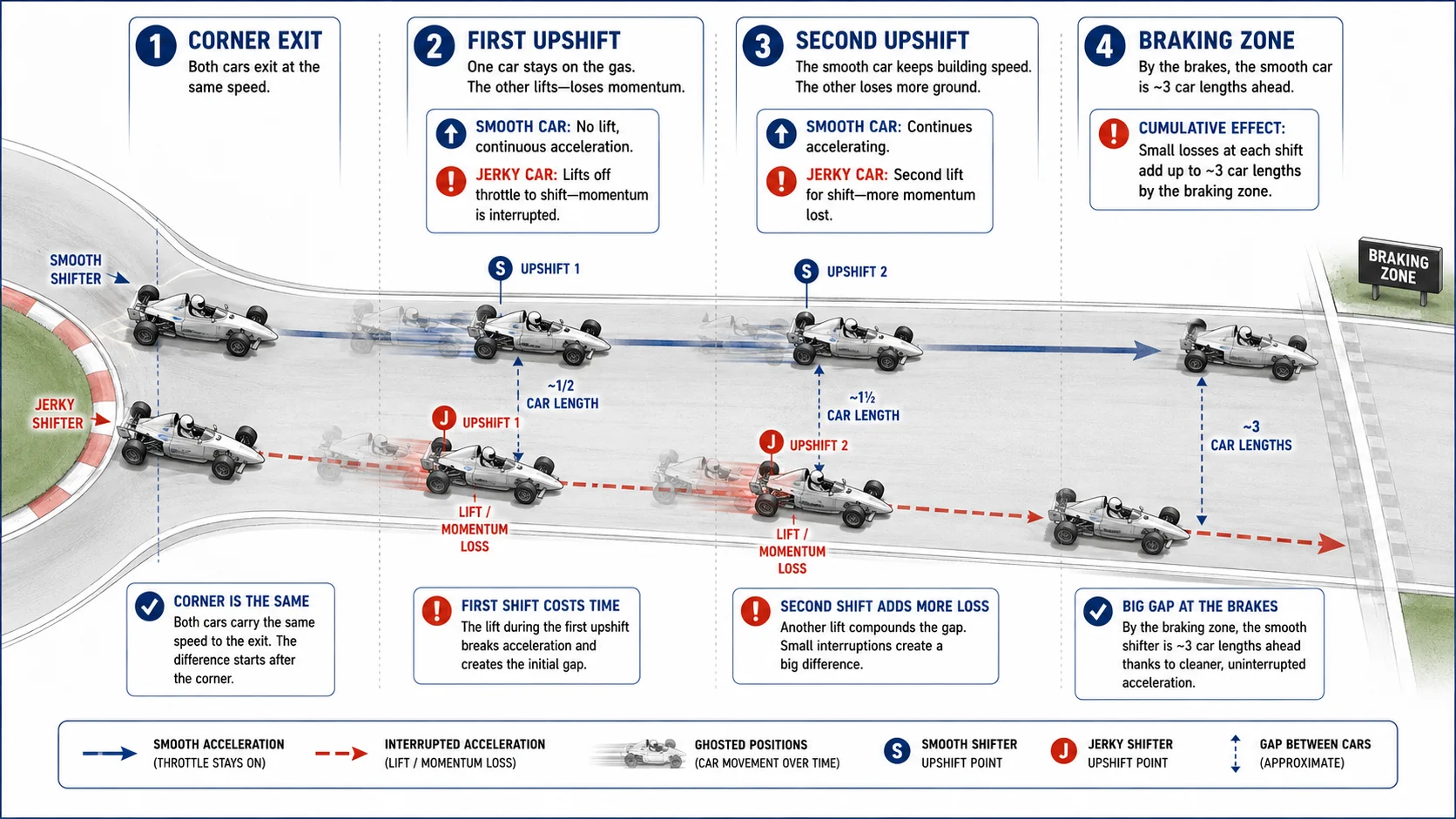
Now the other version. You brake into the hairpin, drop two gears in quick succession, and the rear snaps sideways before you’ve even turned in. You catch it, lose a second, and the driver you were racing is gone. The downshift did that, and you blamed the corner.
This guide is for sim racers in the Ray FF1600, the car where a lot of iRacing careers begin, though the feel you build here transfers to any H-pattern car, virtual or real. The FF1600 has a dog-engagement gearbox, narrow tires, and no downforce. Every shift either loads or unloads the car. Done well, the car never knows the gear changed. Done badly, you bleed momentum on every straight and unsettle the car on every entry.
We’ll fix that with feel, drills, and a clear order to learn them in.
What shifting actually does in this car
The FF1600 gearbox is a dog box, not a synchromesh. The dogs are square teeth that lock a gear to the shaft. They engage instantly when conditions are right and refuse when conditions are wrong. The conditions are simple, and so is what your feet do.
Upshifts are clutchless. The drivetrain has to be unloaded. Lift fully off throttle, flick the lever, back on throttle. The dogs slip past each other when no torque is pinning them together. Your left foot does nothing.
Downshifts get a blip, and while you’re learning, the clutch. The blip does the real work: it raises engine speed to match wheel speed in the lower gear so the dogs settle in cleanly. The clutch just softens the handshake while your blip is still imprecise. As your rev match sharpens, you’ll need it less. Until then, use it every time.
Skip the lift on an upshift and the box grinds or refuses. Skip the blip on a downshift and the rear tires get dragged into spinning the engine up themselves, which costs them grip. On skinny tires with no rear downforce, that is how entries become spins.
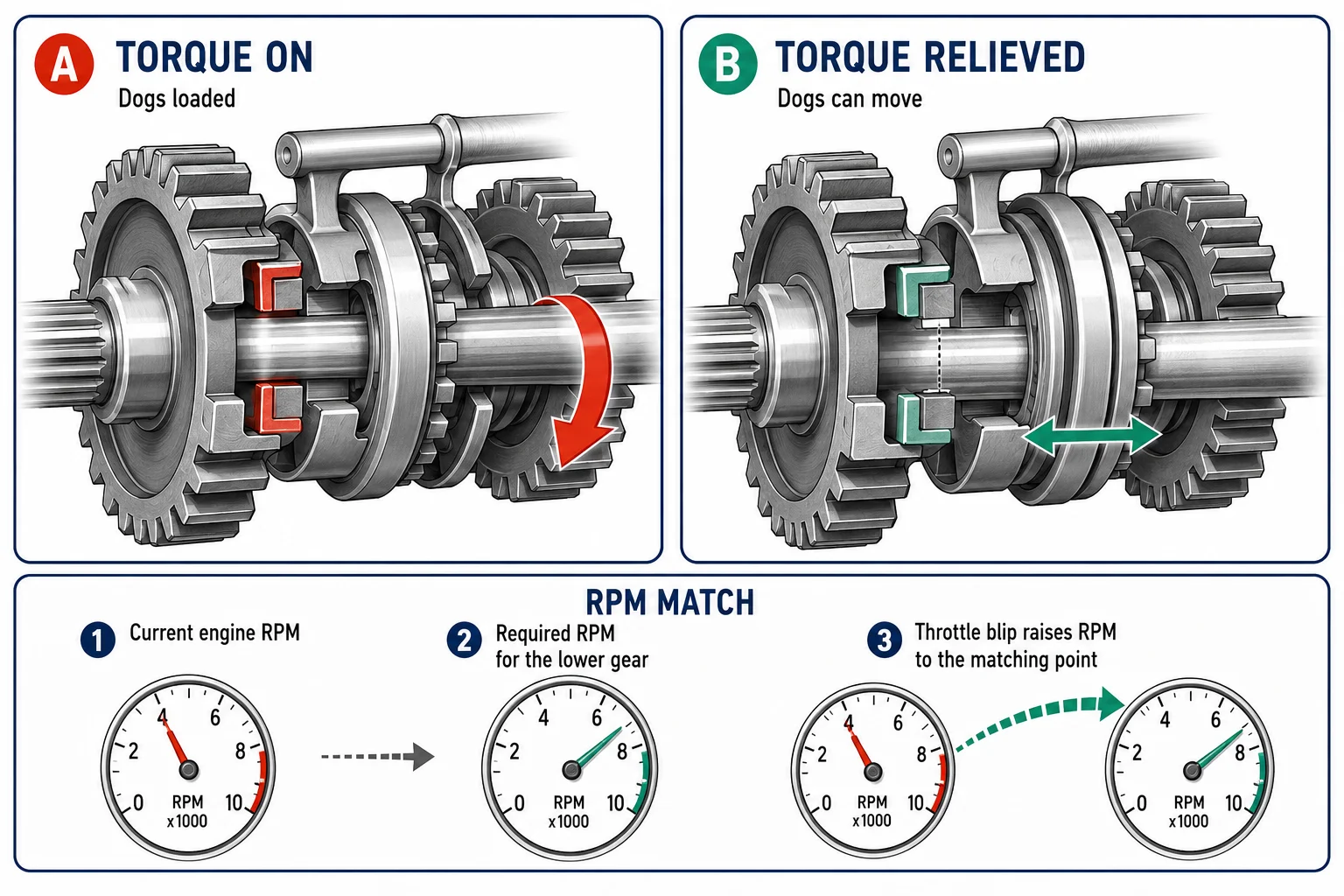
A simple cutaway of a dog gear engagement, showing the square dog teeth lined up between two gears. Left panel labelled “torque on, dogs jammed” with the teeth wedged together. Right panel labelled “torque relieved, dogs slip” with a small gap between them. Below the gears, a tachometer showing engine RPM with two arrows pointing to the correct match speed for the next-lower gear, illustrating what a rev-match achieves.
What good and bad shifts feel like
The pedal and the lever teach you faster than any article can.
A good upshift: the lever moves like it was waiting for you. No resistance, no notch in the gate. The engine note steps down half an octave and the car keeps pulling. A bad one: the lever hangs, the engine pitches up, and the car loses a tenth while you hunt for the gear.
A good downshift: one clean blip, the rear stays planted, the lower gear catches without complaint, and you brake straight to the corner. A bad one: a jerk through the chassis, the steering goes light, the car yaws when you didn’t ask it to. Sometimes you catch it, sometimes you don’t.
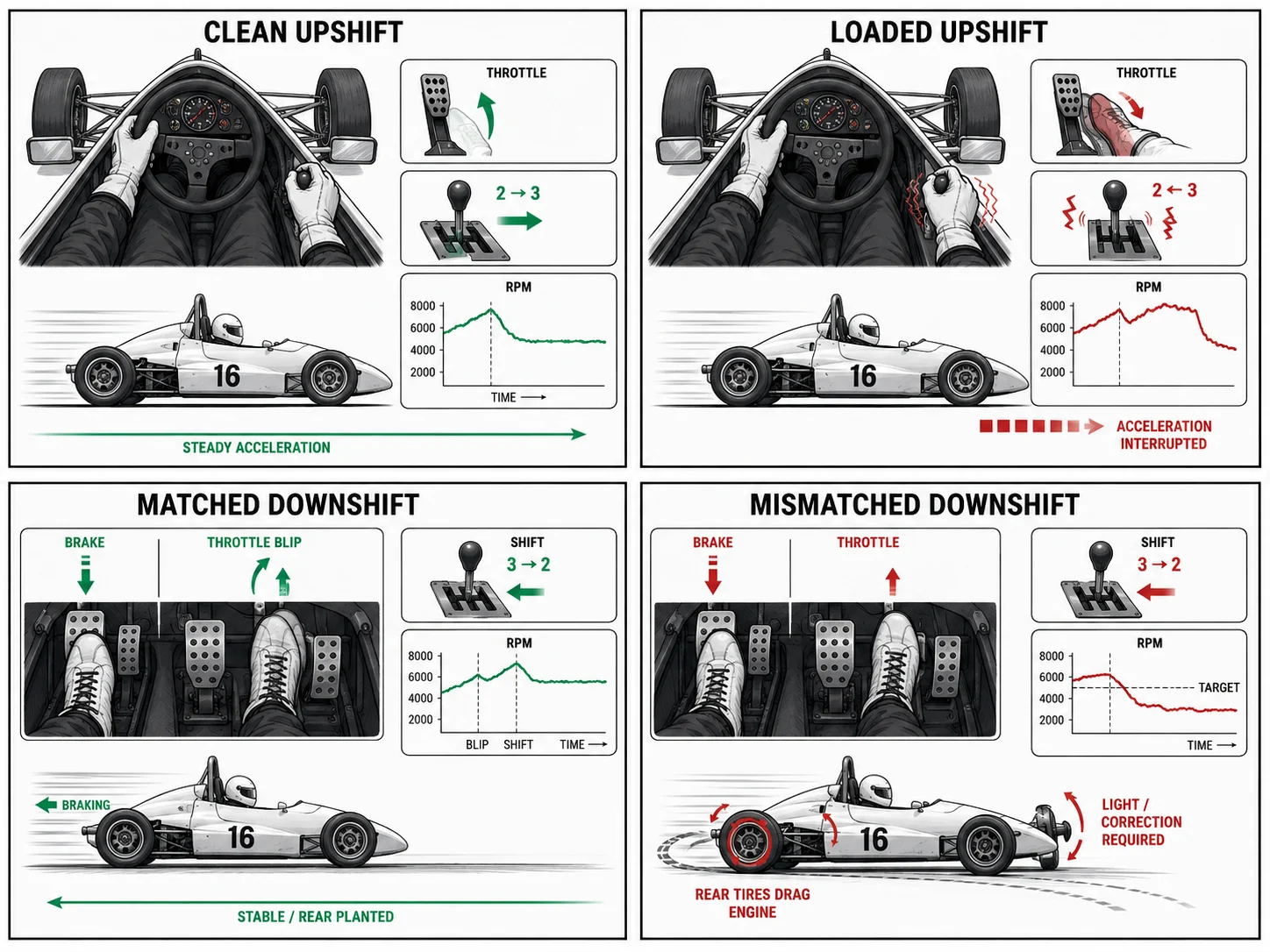
Most rookies have never felt a clean shift in this car, so they don’t know what to aim for. Once you feel one, you stop accepting the bad ones.
The mistakes that matter most
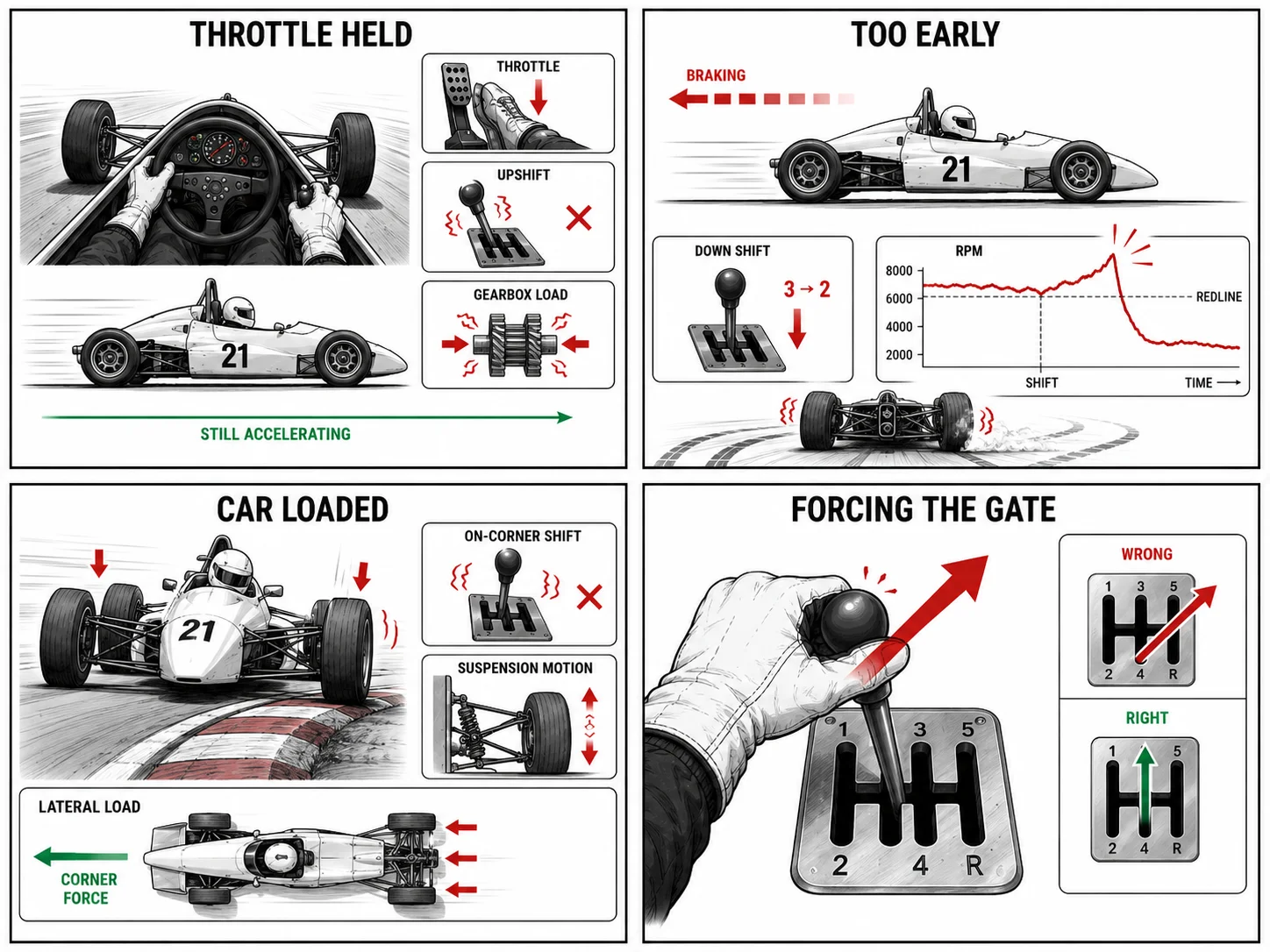
Nearly every shifting problem in this car traces back to four errors. The drills below attack each one directly.
- Holding throttle through the upshift. The dogs cannot release while the engine is pulling. Lift fully, even if only for a fraction of a second.
- Grabbing downshifts too early. The engine cannot accept the lower gear yet, so the rear tires get pulled into slowing it. The rear goes light, then breaks loose. Let the revs fall first.
- Shifting mid-corner or on curbs. A loaded, working tire has nothing to spare for a gearchange, and a bouncing car turns a small shift error into a big one. Finish every shift in a straight line, on settled suspension.
- Forcing the gate. Diagonal pressure or a death grip binds the selector. Move the lever in a straight line with a relaxed hand. If a gear refuses, you missed the lift or the blip. The gearbox tells you exactly what you did wrong.
The method: one drill per session
You cannot fix everything at once. Pick one drill, run it for a session or two, and move on only when it has become automatic — not when it worked once. Most drivers who practice regularly get through the whole ladder in three or four weeks. The drills stack: upshifts before downshifts, mechanics before feel, feel before refinement.
Drill 1: Lift and flick
Objective. Clean clutchless upshifts.
Process. Pick a long straight. Drive up through the gears focusing only on the upshift: lift fully, flick, back on throttle. Identical timing every time. Ignore lap time.
What to feel. No resistance in the lever; the engine note steps down without a stumble. If the lever fights you, your lift was incomplete or too short.
Done when. Every upshift on the straight feels like nothing happened.
Drill 2: Heel-toe ladder
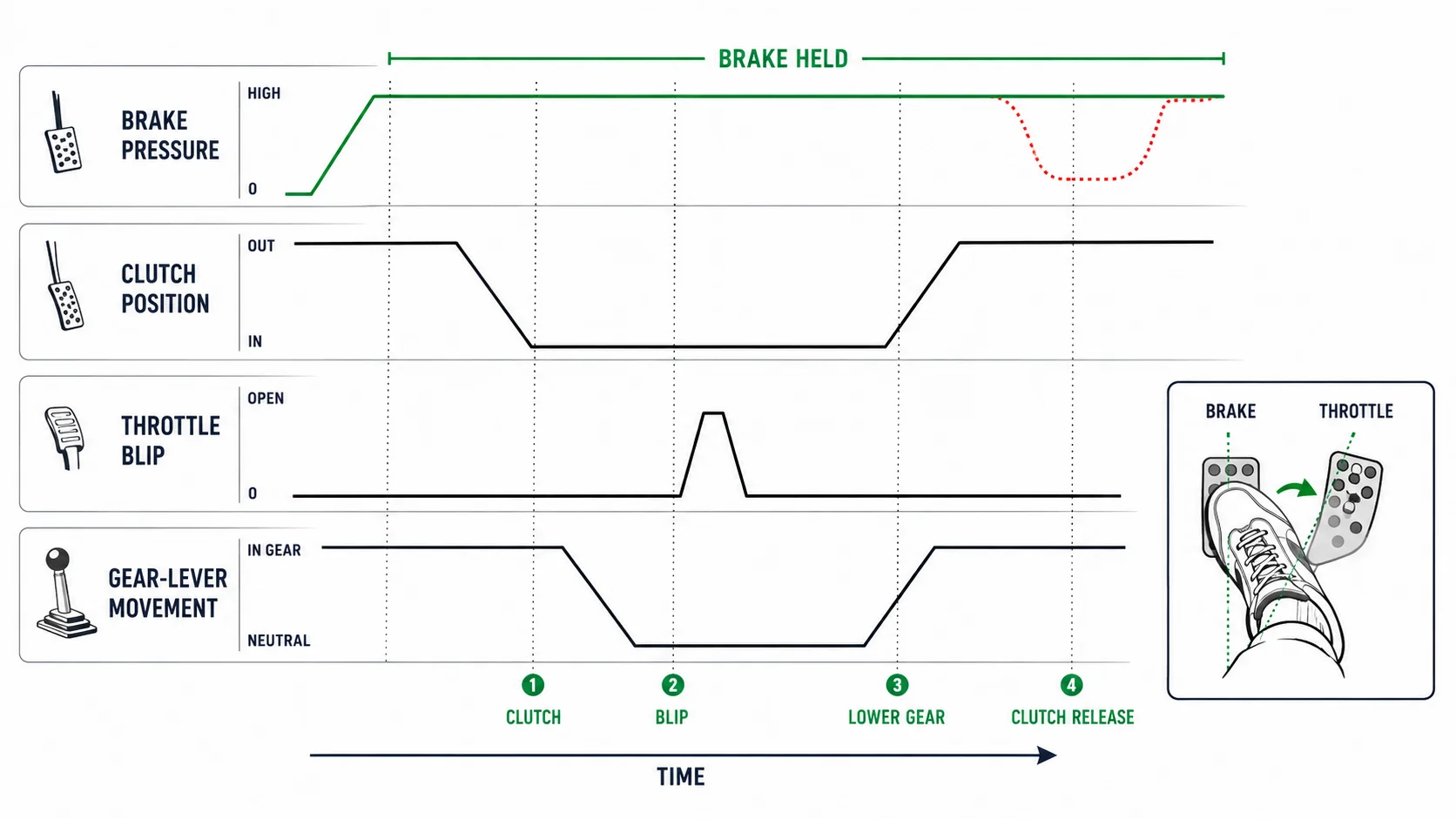
Objective. A consistent blip inside a downshift sequence.
Process. Find a corner with three or four downshifts. Brake hard in a straight line and practice the cadence: brake, blip, clutch, gear. While you’re learning, it’s fine to ease brake pressure slightly at the blip. Treat that as a crutch. The end goal is full, steady brake pressure straight through the blip. Ten laps, rhythm only, no pace.
What to feel. The engine catches each gear without a lurch and the car stays arrow-straight.
Done when. The cadence is one fluid motion and your brake trace no longer dips at each blip.
Drill 3: Audio only
Objective. Shift by sound, not by sight.
Process. Turn off the shift lights and cover the tach. Drive a stint by engine note alone. The power flattening before redline is your upshift point; the revs falling toward the match point is your blip cue.
What to feel. Your eyes come off the dash and go up the road. Shifts get earlier and smoother once vision is free.
Done when. You can run clean laps without ever looking down. That feel transfers to every car you drive after this one.
Drill 4: No shifts in corners
Objective. The discipline to keep the gearbox out of the corner.
Process. Run a stint with one rule: zero shifts between turn-in and exit. Misjudged the gear? Live with it. Drive the corner in third when you wanted second, and feel what each gear does.
What to feel. A calmer car mid-corner. The chassis settles when the gearbox stops interrupting it.
Done when. You stop fearing the wrong gear, because you’ve learned it is almost always faster than a panic shift.
Drill 5: Delayed downshift
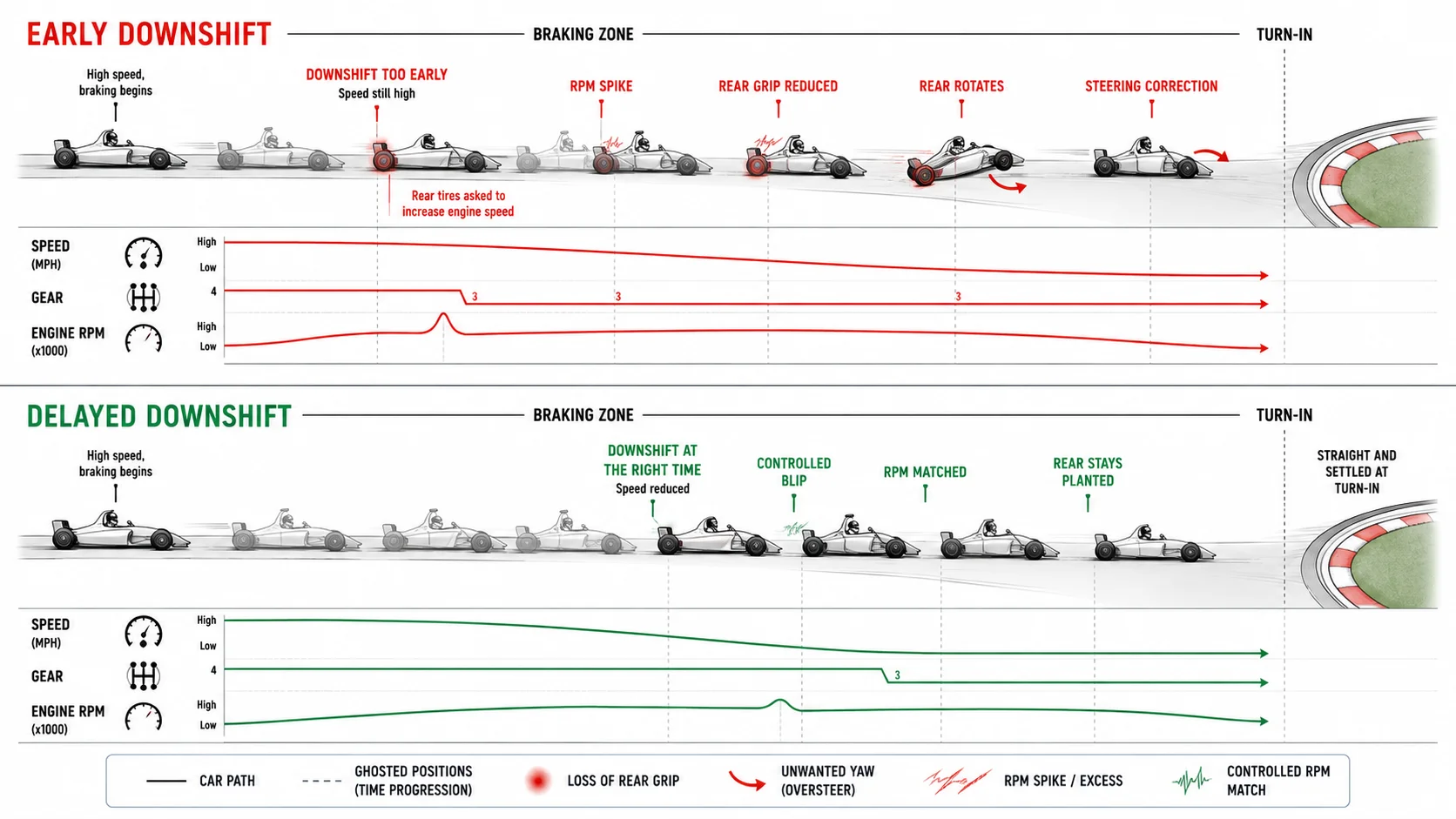 Objective. Find how late you can take the final downshift.
Process. Pick a corner where your entries feel nervous. Delay the last downshift half a second beyond what feels right. Then a full second. Then push until the engine almost bogs on exit. Take gears one at a time. Skipping from fourth to second makes the rev gap enormous, and unless your match is precise, the rear locks.
What to feel. Entry stability improves as the downshift moves later; exit punch fades when you go too far. Find the point between them.
Done when. You’ve replaced “shift at the brake marker” with the latest downshift that still lets the engine pull on exit. This habit fixes most rookie spins.
Drill 6: A/B blip intensity
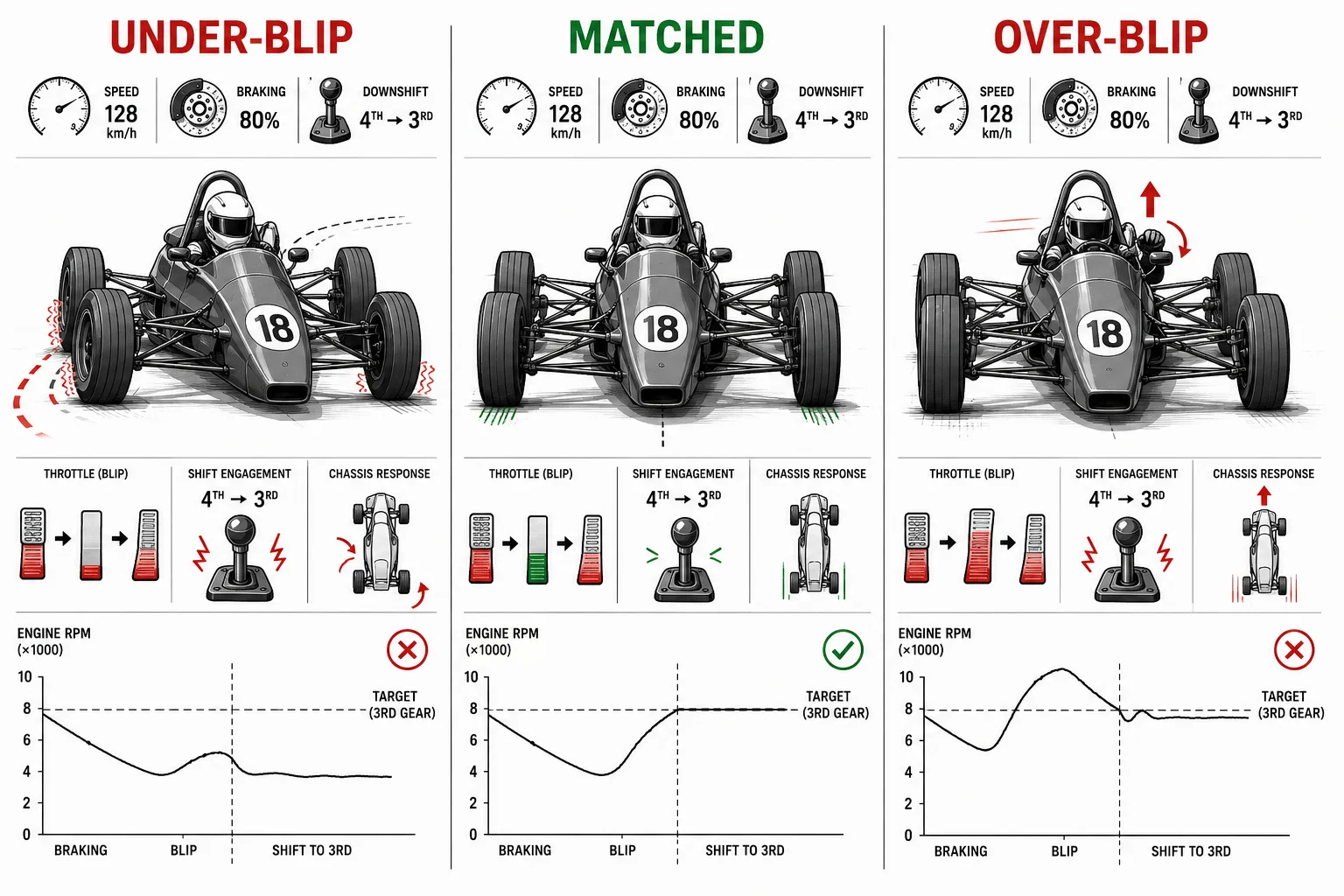
Objective. Calibrate the size of your blip.
Process. One downshift. Five laps deliberately under-blipping, five deliberately over-blipping, five at what feels right. Change nothing else.
What to feel. Too small and the rear gets tugged as the tires drag the engine up. Too big and the car surges forward at engagement. Right, and the car simply changes gear.
Done when. You have a felt reference you can recalibrate at any track or ratio in a lap or two.
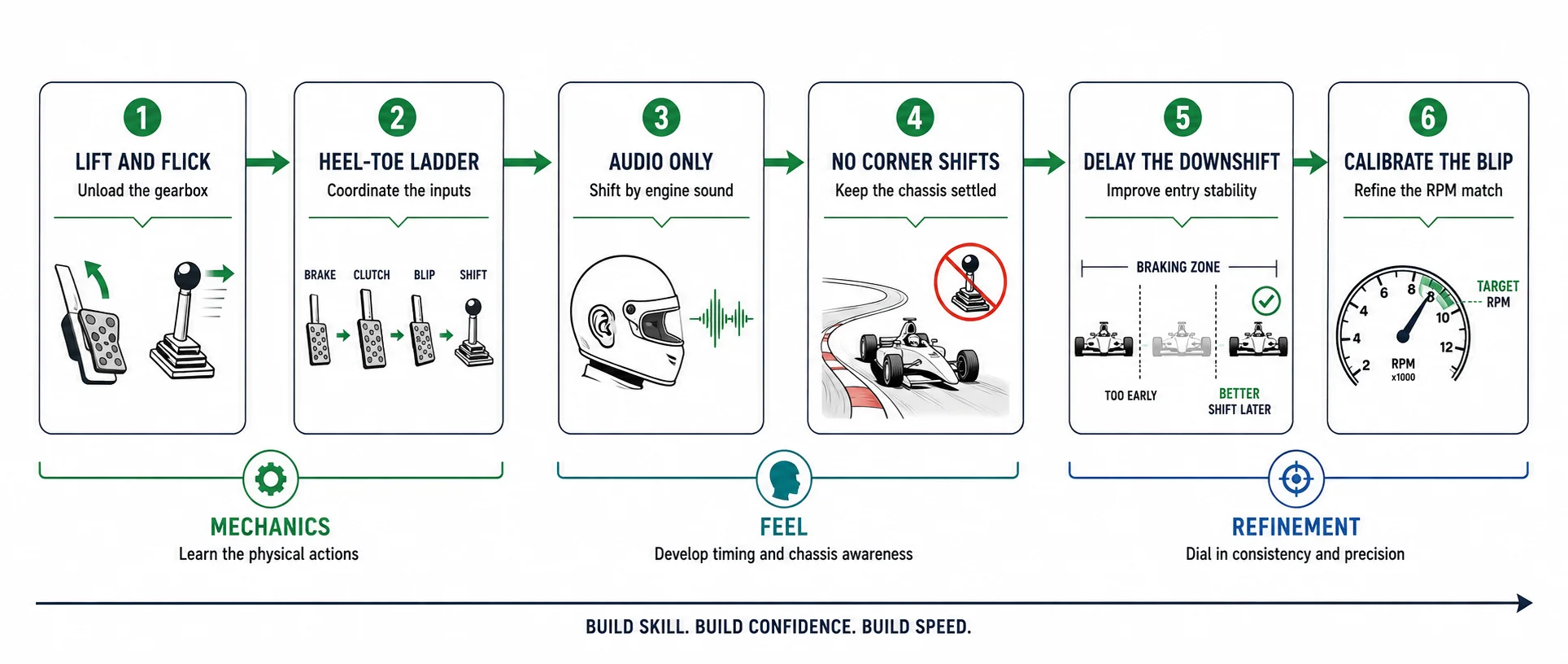
A horizontal progression diagram of the six drills. Lift and flick, then heel-toe ladder, then audio only, then no shifts in corners, then delayed downshift, then A/B blip intensity. Arrows connect each step. Below each box, a single line describing the skill it builds. The diagram should make clear that the drills stack: upshifts before downshifts, mechanics before feel, feel before refinement.
How your shifting will change
The habits that feel safe today will feel slow in three months.
Beginners overshift because they think engine braking matters. In a 1600cc Formula Ford it contributes only a small slice of your total deceleration. You’ll feel it in first and second gear at low speed, but the brake pedal does the overwhelming share of the work. The downshift is there to set up the exit. The first big improvement is exactly that click: brake with the brake, shift for the exit. Your downshifts get later and your entries get smoother.
The second improvement is mental. Shifts move from foreground to background. Early on, you think about every gear. Later, they happen while your brain is on the apex and the gap behind. You’ll know a shift was clean because the car didn’t complain, and that’s all the attention it gets.
Watch the top splits and you’ll notice something else: fast drivers often carry one gear higher than rookies through the same corner. A taller gear softens the throttle response mid-corner, which makes the car easier to place, and their exit technique covers the lost punch. They can afford it because their shifts are reflex; they almost never miss one. The route there is repetition.
You will also see fast drivers downshift mid-corner and get away with it. They are driving at a level where these rules have become guidelines. Until you are there, follow the rules.
Somewhere in the middle of all this, you’ll watch a replay and notice the gap to the driver who used to beat you out of every corner has stopped growing on the straights. A few weeks later, it starts shrinking.
Your next three sessions
Session one: fifteen minutes of lift-and-flick, fifteen minutes of the heel-toe ladder, then a short race where you grade yourself on one thing only: did any shift cause chaos? Note the corners where it did. Session two: drill those corners. Session three: race again. Repeat the cycle three or four times and the gearbox stops being a thing you operate and becomes a thing that operates itself, which frees your attention for the race.
Next in this series: braking, where the other half of your entry problems live. If you want the six drills as a one-page card to keep on your second monitor:
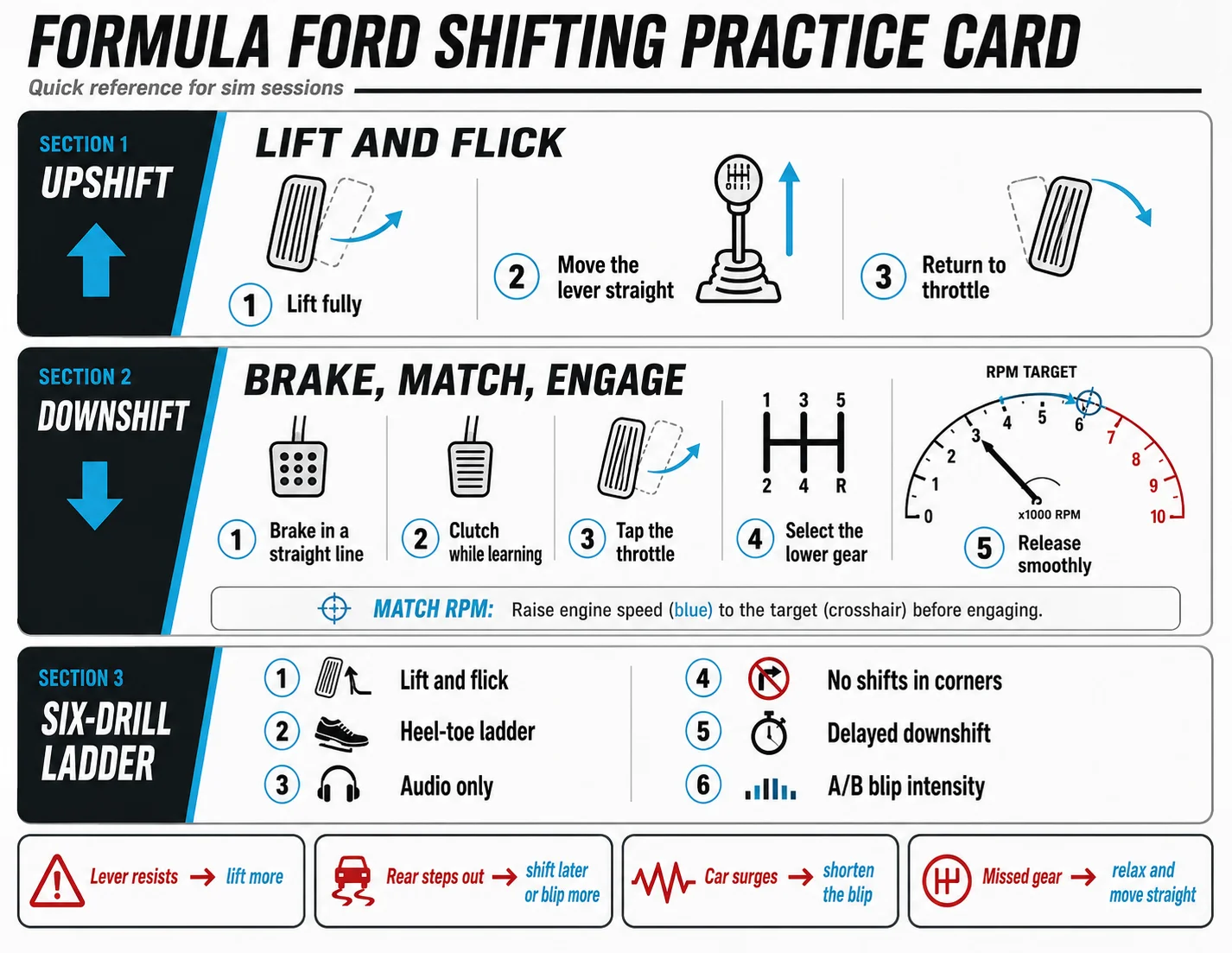
Quick symptoms reference
| Symptom | Likely cause | What to change |
|---|---|---|
| Upshift hangs or grinds | Throttle still on during the shift | Lift fully before flicking the lever |
| Rear breaks loose on downshift | Over-rev, no rev match | Blip harder or delay the downshift |
| Missed gear or false neutral | Side-loaded gate, rushed motion | Move the lever straight, relax the hand |
| Engine over-revs on engagement | Downshift too early | Wait for revs to drop, then blip and engage |
| Car upset on curbs after a shift | Shifted while the car was bouncing | Finish all shifts before the curb |
| Engine bogs after upshift | Upshifted too early in the rev range | Hold the gear, listen for power to flatten |
| Spin on corner entry | Late panic downshift while turning | Downshift only in a straight line, even if it feels late |
| Lurch forward during a blip | Blip too long, adding power instead of matching | Shorten the blip to a tap |
| Inconsistent shifts lap to lap | Your inputs varying, not the car | Drill consistency before chasing lap time |